Key takeaway
A TradeKind trade profile is best used as a screening tool: check the trade, area, description, photos and reviews, then ask a few direct questions before you get in touch.
TradeKind helps homeowners find local Sussex trades
Browse approved local trade profiles, compare nearby Sussex trades or post a job for free.
A good trade profile should help you answer one simple question before you make contact:
Does this business look like a sensible match for the job I need doing?
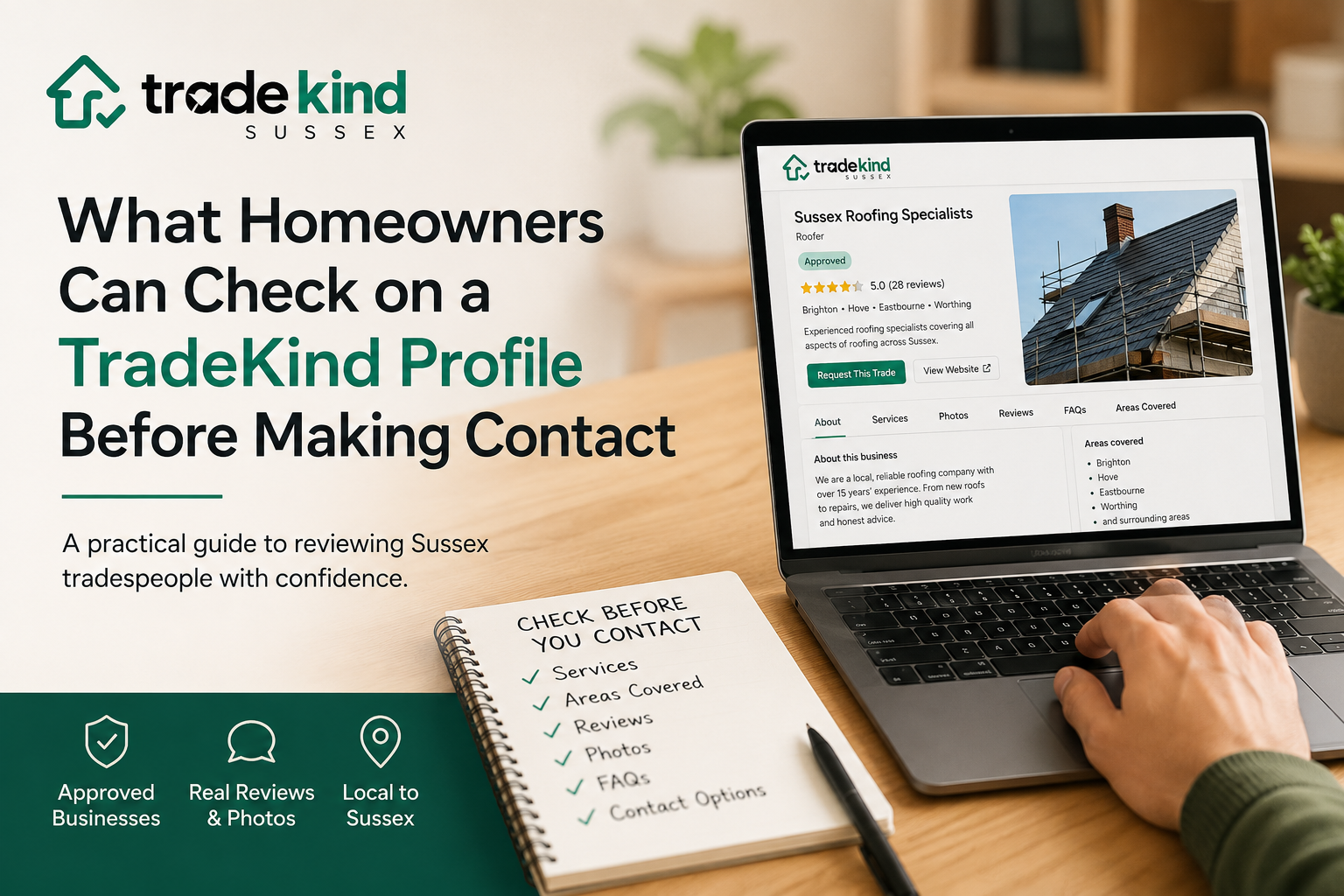
TradeKind profiles are designed to give homeowners useful information before they send a request. You can check the type of work a business carries out, the areas it covers, the photographs it has uploaded, the questions it has answered and any reviews shown on the profile.
You do not need to treat every profile like an investigation. The aim is to gather enough information to decide whether the business is worth contacting.
Start with the work itself, then look at the location, evidence and detail around it.
Start with the type of work the business carries out
The first thing to check is whether the business actually does the kind of work you need.
A main trade category gives you a useful starting point, but it may not tell the whole story. A builder might focus on extensions and structural alterations, while another mainly handles smaller repairs. A decorator may work on domestic interiors but not take on exterior projects. A plumber may deal with repairs and bathrooms but not provide emergency call-outs.
Read the profile description and services rather than relying only on the business name or category.
Look for clear references to work similar to yours.
For example, if you need a bathroom renovated, a profile mentioning bathroom installations, plumbing, tiling and related finishing work may be more relevant than one that simply says “all plumbing undertaken”.
If you need one room redecorated, check whether the decorator accepts smaller domestic jobs rather than assuming every decorating business will want the work.
The closer the profile matches your actual job, the more useful the first conversation is likely to be.
Check whether the business covers your part of Sussex
TradeKind focuses on East Sussex, West Sussex and Brighton & Hove.
Each business chooses the towns or service areas it says it covers. Check that your property falls within one of those areas before making contact.
A business based in one part of Sussex may work across several nearby towns. Another may keep its working area much smaller.
For example, a tradesperson may cover Worthing, Lancing, Shoreham-by-Sea and Brighton & Hove but not travel regularly to Hastings or Eastbourne.
Being listed for your town does not guarantee that the business will be available or willing to take every job there. It does, however, show that the area falls within the coverage published on the profile.
Location matters for more than distance. Travel time, parking, access and the size of the job may all affect whether a tradesperson can help.
Read the business description properly
The description is where a business can explain what it does in its own words.
A useful description should give you a clearer idea of:
- the type of work the business regularly carries out
- the size of jobs it tends to accept
- the kinds of properties it works on
- the experience behind the business
- the areas it covers
- anything it does differently
Do not worry if the writing is not polished. Many excellent tradespeople are better at their work than they are at writing about it.
What matters is whether the description gives you real information.
A strong description might explain that the business specialises in domestic rewires, kitchen installations and fault finding. A weak one may contain only broad claims such as “high-quality work at competitive prices”.
General statements are not automatically a warning sign, but they do not tell you much. Look for specific details that connect the business to the job you need done.
Look at photographs of previous work
Photographs can be one of the most useful parts of a trade profile.
They can help you see the type, scale and finish of work the business chooses to show.
When looking through a gallery, ask:
- Does the work look relevant to my project?
- Are there several examples or only one?
- Do the photographs show completed jobs clearly?
- Can I see useful detail rather than distant or heavily edited images?
- Does the business appear to carry out this kind of work regularly?
The most useful photographs are not always the most polished. A clear before-and-after image, a close-up of finished detail or a set of photographs showing progress through a job can tell you more than a single staged picture.
For decorating work, look at preparation, lines, edges and the finished surfaces.
For roofing, building or landscaping, look for examples that appear similar in size and type to your own project.
For bathrooms and kitchens, look beyond the overall appearance. Details around tiling, fittings, joins and finishing can be useful.
Photographs should support the information on the profile, not replace a conversation about your particular job.
Check the services listed
A business may offer several related services.
The services section can help you work out whether your request sits comfortably within the work it normally takes on.
For example, a roofing business might list:
- roof repairs
- pitched roofing
- flat roofing
- guttering
- leadwork
- chimney repairs
That is more useful than seeing only the word “roofer”.
A gardener might list regular maintenance, hedge cutting and garden clearance but not landscaping or fencing. An electrician might handle domestic installations and fault finding but not commercial work.
Choose businesses whose listed services genuinely line up with what you need.
If your job sits between two trades, read the profile carefully and explain the problem clearly when you make contact. You do not need to diagnose the cause yourself.
Use the profile questions and answers
Some TradeKind profiles include answers to common customer questions.
These can save time and help you understand how the business works before you send a request.
Useful answers may cover:
- whether the business provides quotations
- the size of jobs it accepts
- whether materials are supplied
- how far the business travels
- whether emergency work is available
- typical booking times
- whether deposits are required
- the kinds of properties it works on
Pay attention to answers that matter to your situation.
If you need work completed within a particular period, an answer about current booking times may be useful. If the property has difficult access, you may want to know whether the business normally visits before quoting.
A thoughtful answer can also show how clearly the business communicates.
Read reviews with context
Reviews can help you understand what previous customers valued about the business.
Do not look only at the overall score. Read the wording where reviews are available.
A useful review may mention:
- the type of work completed
- whether communication was clear
- whether the business arrived when agreed
- how changes were handled
- whether the property was left tidy
- whether the customer would use the business again
Recent and detailed reviews are often more informative than very short comments.
It is also worth checking whether the reviews relate to work similar to yours. A business may have excellent feedback for small repairs, but your project may be a much larger renovation.
Reviews are one part of the picture. They do not guarantee how a future job will go, but they can help you form better questions before making contact.
Look for a website or other business information
A TradeKind profile may include a link to the business’s own website.
That can give you another place to look at services, projects, contact details and background information.
When visiting an external website, check whether the information is consistent with the TradeKind profile.
You might compare:
- the business name
- the services offered
- the areas covered
- photographs of work
- any qualifications or memberships claimed
- the contact information shown
Small differences are not always important. Businesses change their services and coverage over time, and one page may not have been updated as recently as another.
Large or confusing differences are worth asking about.
Not every good tradesperson has a large website. A simple site or no separate website does not tell you whether the workmanship is good or bad. Use it as additional information rather than a pass-or-fail test.
Check whether the profile shows a team or partner trades
Some jobs involve more than one trade.
A bathroom project may need plumbing, tiling, electrical work and decorating. An extension may involve builders, roofers, electricians, plumbers and plasterers.
TradeKind Fleets allow businesses to show Team members and Partner trades they work with.
This can help you understand whether the person you contact works alone, has employees or regularly works alongside other independent businesses.
It may also give you useful questions to ask:
- Who would carry out the work?
- Will any part of the job be passed to another business?
- Who is responsible for organising the other trades?
- Will I receive one quotation or separate quotations?
- Who should I contact if there is a problem?
A visible trade connection is useful information, but you should still ask how the arrangement would work for your job.
Understand what Approved means
TradeKind manually reviews trade profiles before allowing them to appear publicly.
An Approved profile has passed that review and has been accepted for display on the platform.
It does not mean that TradeKind guarantees every claim on the profile or the outcome of future work.
Unless a separate check is clearly stated, approval does not automatically confirm:
- every person’s identity
- qualifications
- insurance
- memberships
- previous workmanship
- current availability
- prices
- suitability for your exact project
- the final result
Approval is a useful starting point. It tells you the profile has not simply appeared publicly without being reviewed first.
You should still make the checks that are relevant to your job.
For a fuller explanation, read what Approved means on TradeKind.
Notice what is missing as well as what is shown
A profile does not need to contain every possible detail to be worth contacting.
However, missing information can help you decide what to ask next.
For example:
- No photographs? Ask for examples of similar work.
- No clear service areas? Confirm that the business covers your location.
- No mention of job size? Ask whether the work is suitable.
- No reviews yet? Ask for references or examples where appropriate.
- No information about timing? Ask about current availability.
- No mention of insurance or qualifications? Check whether they matter for the job.
A newer profile may naturally have fewer reviews or photographs than an established one.
That does not automatically make it unsuitable. It simply means you may need to ask a few more questions before deciding whether to proceed.
Check whether the profile feels relevant, not just impressive
A profile can look professional and still be wrong for your job.
The best choice is not always the business with the longest description, the most photographs or the largest team.
A smaller local business may be ideal for a repair. A larger company may be better suited to a project involving several trades. A specialist may be more appropriate than a general business when the job requires particular experience.
Try to judge relevance rather than presentation alone.
Ask yourself:
- Does this business regularly do the work I need?
- Does it cover my area?
- Can I see evidence that feels relevant?
- Does the profile answer my main questions?
- Is there anything important I still need to confirm?
If the answer is mostly yes, the business may be worth contacting.
Questions to ask when you make contact
A TradeKind profile should help you narrow down your options, but the next conversation still matters.
When contacting a business, explain the job clearly and ask the questions that affect your decision.
Depending on the work, you may want to ask:
- Do you regularly carry out this type of job?
- Do you cover my exact location?
- Are you currently taking on work of this size?
- Would you need to visit before quoting?
- What information or photographs would help?
- Who would carry out the work?
- Are materials included?
- Is anything likely to be excluded from the price?
- Are any qualifications, registrations or insurance relevant?
- What is your current availability?
- How would payments be arranged?
You do not need to ask everything at once.
Start with the questions that tell you whether the business is a realistic fit. More detailed points can be covered before you agree to the work.
For larger jobs, compare more than one business
For a small and straightforward repair, you may decide that one suitable business is enough.
For more expensive or complicated work, comparing several businesses can give you a better idea of:
- the likely price
- what is included
- the proposed approach
- the expected timescale
- how clearly each business communicates
- whether the quotations are genuinely comparable
The cheapest quotation is not always the best value.
A lower price may exclude materials, preparation, waste removal or finishing work that another quotation includes. Make sure you are comparing the same scope of work.
Written quotations are especially useful for larger projects.
They give both sides something clear to refer back to and reduce the risk of misunderstanding later.
What to check before agreeing to work
Before the job begins, make sure the main details have been agreed.
That may include:
- what work will be completed
- what is not included
- who will supply materials
- the price or how it will be calculated
- any deposit required
- when payments will be due
- the expected start date
- the likely completion time
- who will carry out the work
- how changes or extra work will be handled
- whether any guarantee is provided
For regulated or specialist work, check the qualifications, registrations or approvals that apply.
Keep copies of quotations, messages, invoices and any changes agreed during the job.
A profile is the beginning of the decision, not the end
TradeKind profiles are there to make the first step easier.
They allow you to look at local businesses, understand what they do and decide whether making contact is worthwhile.
The most useful approach is simple:
- Check that the trade and services match your job.
- Confirm that the business covers your part of Sussex.
- Look at photographs, reviews and useful profile details.
- Note anything important that still needs to be confirmed.
- Ask clear questions before agreeing to the work.
You do not need perfect information before sending a request.
You only need enough to decide that the business appears relevant and worth speaking to.
Frequently asked questions
Which business details can a profile show?
A public TradeKind trade profile may show the business name, selected trade categories, service areas, a description, photos, FAQs and reviews where available. Profiles are manually reviewed before publication, but approval only means the profile can appear publicly; it is not a guarantee of identity, qualifications, insurance or workmanship.
How should services and service areas be checked?
Check that the trade offered matches the job you need and that your Sussex town falls within the business's listed service area. If a profile only covers some locations, do not assume it will take every job in the county. For direct requests from a profile, the business must offer the trade and cover the town.
How useful are photos and reviews?
Photos can show the type and standard of work a business chooses to display, while reviews can give you a sense of previous customer experiences where available. Use both as part of a wider check rather than as proof of suitability, because profiles do not guarantee results, availability or current capacity.
What should I ask before proceeding?
Ask whether the business currently covers your area, whether it regularly does the type of job you need, when it could visit, and what information it needs from you next. For larger or more technical work, ask about insurance, relevant experience, timings and how pricing is handled before you agree anything.
Explore trades across Sussex
These are some of the main trades and Sussex areas you can browse on TradeKind. You can also explore many more trades, towns and villages across East Sussex and West Sussex, including Brighton & Hove.
Browse by Sussex area
Can’t see what you need? Browse the full Sussex Trades Directory to explore more trades and areas.
Browse all trades and areasKeep reading

How TradeKind Matches Homeowner Jobs With Local Sussex Tradespeople
TradeKind uses the job category, description and Sussex town or service area to show approved businesses relevant work. Tradespeople then decide whether to respond, and if no match appears, the request stays saved.
How to Find a Reliable Tradesperson in Sussex
A practical Sussex homeowner guide to finding, checking and choosing a reliable local tradesperson for repairs, improvements and larger home projects.
Need a local Sussex trade?
TradeKind connects Sussex homeowners with local trades — free to use, with no hidden fees.